Double Room
A deluxe double room with its own bathroom and generous natural light — quiet comfort for a stay for two. We have several double rooms; we confirm the available one for your dates.
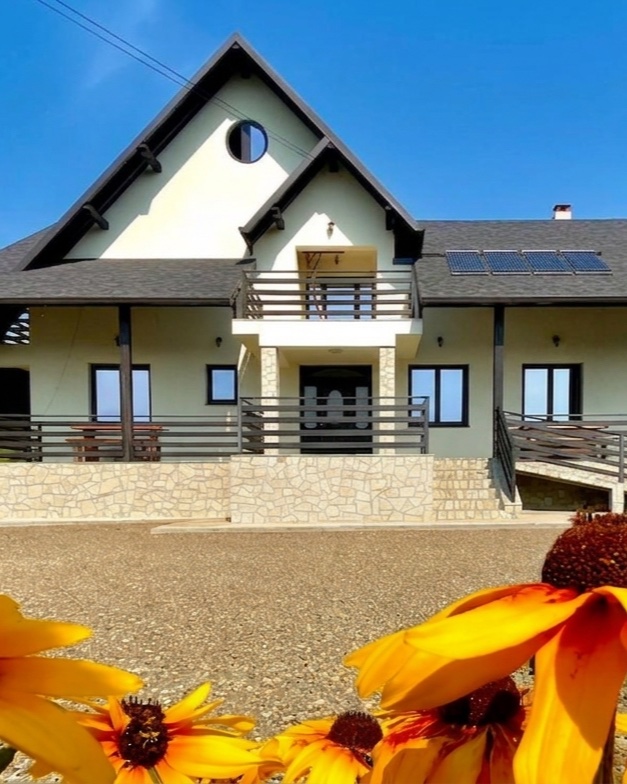
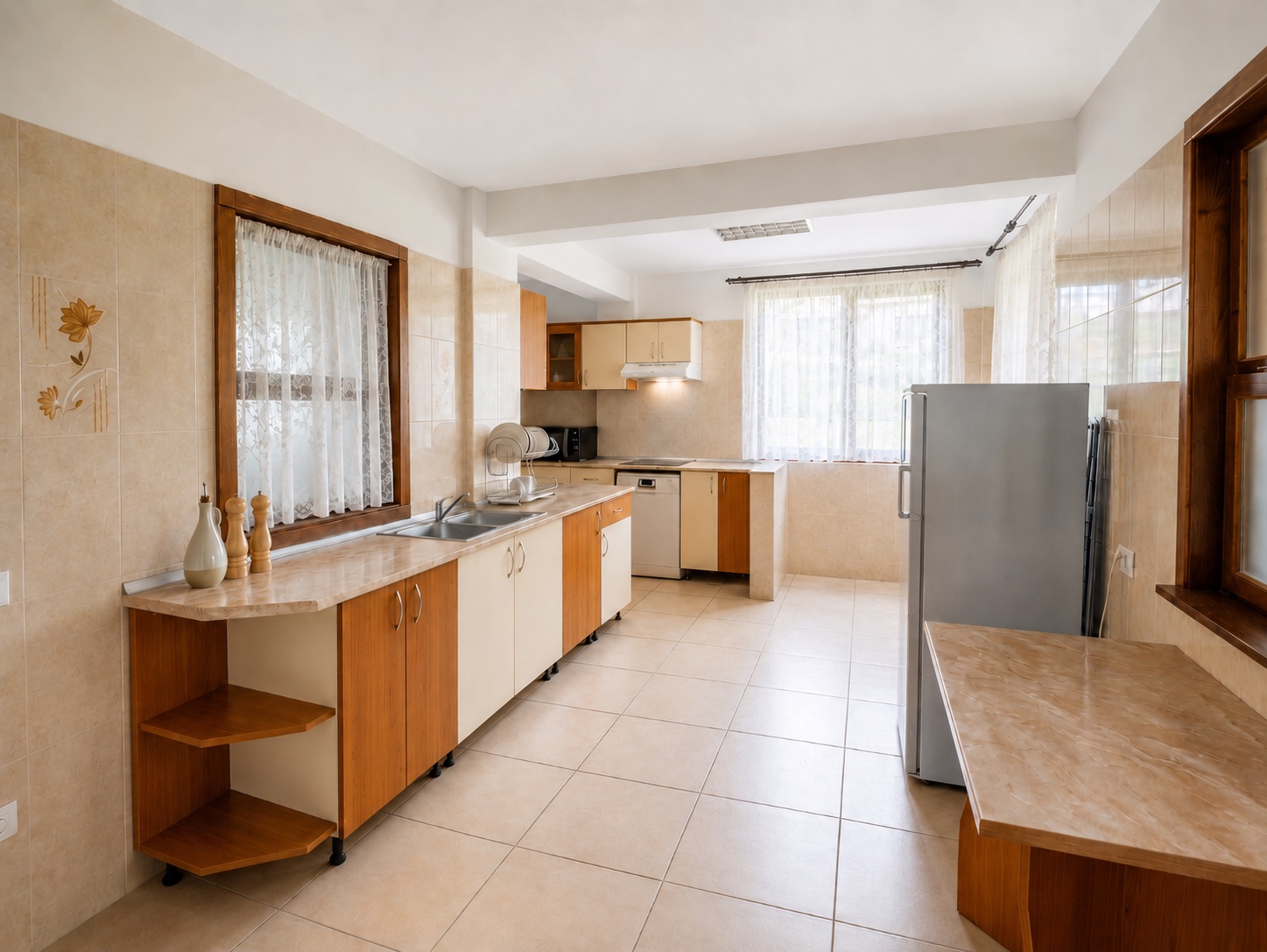
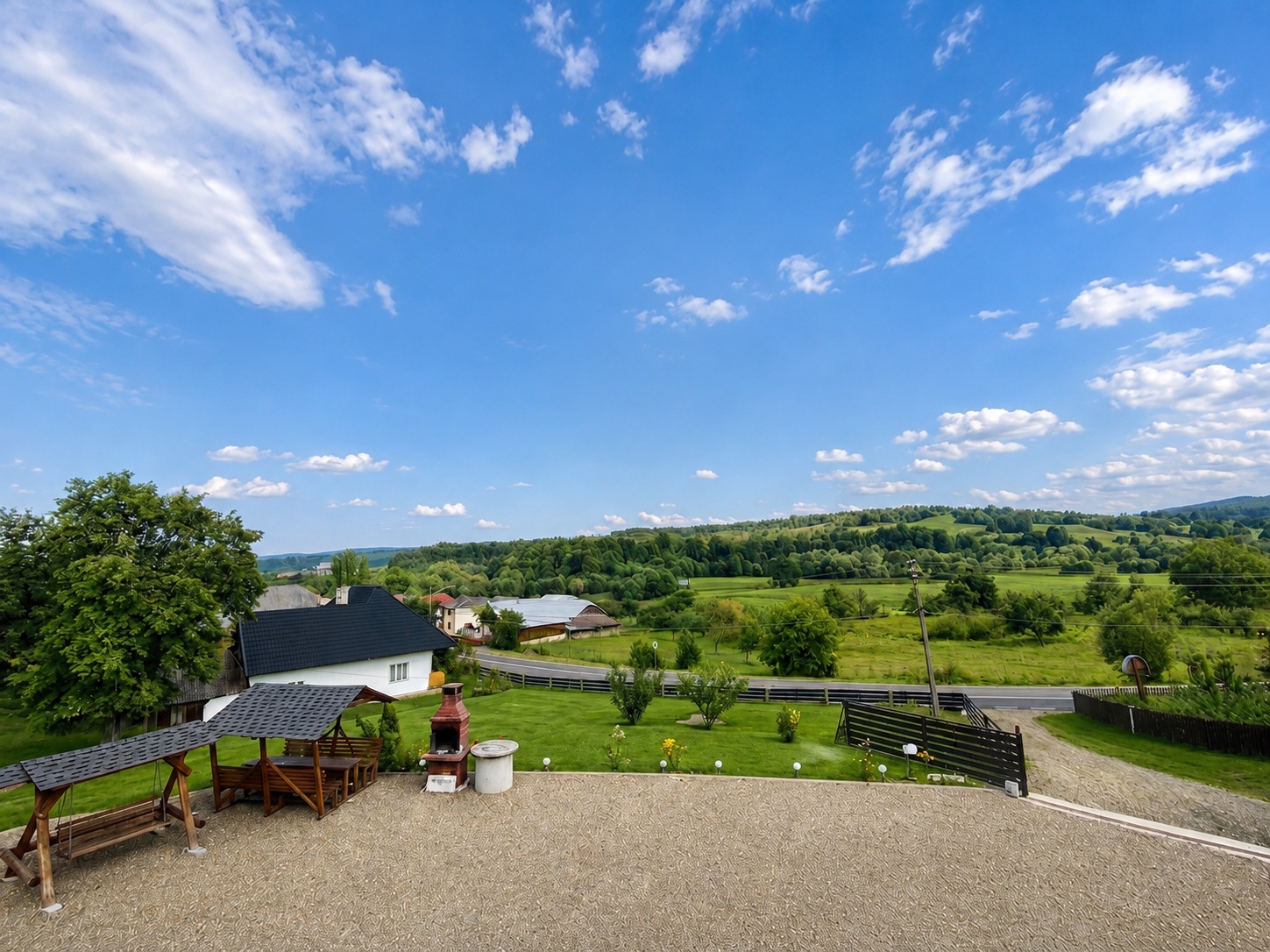
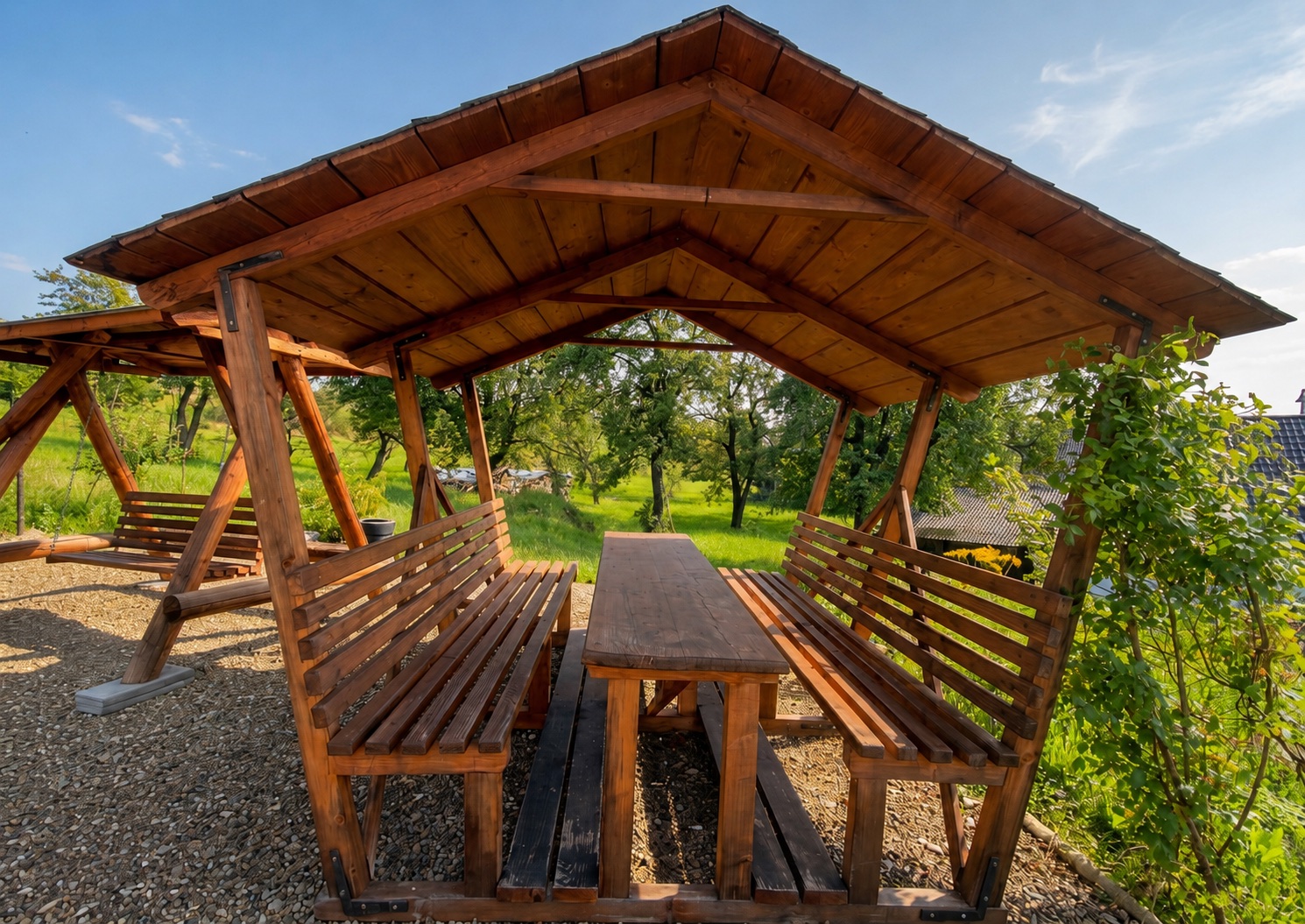
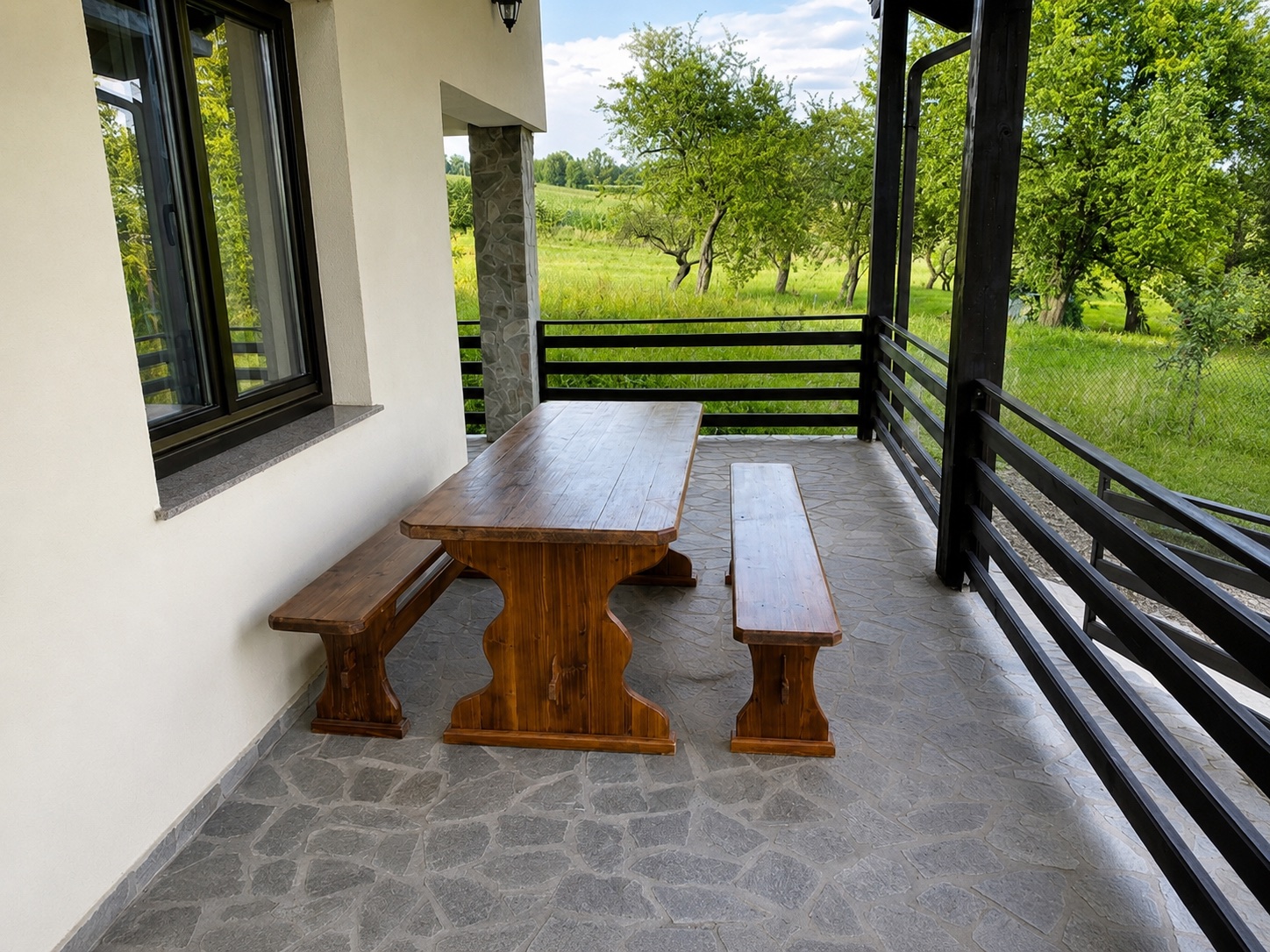
A bright, peaceful house in Cacica, ideal for families and groups who want to discover Bucovina, the Cacica Salt Mine and the monasteries nearby. Rooms with private bathrooms, a fully equipped kitchen, a courtyard and a gazebo.
Set in a quiet area, close to the Cacica Salt Mine and the Catholic Basilica, Casa Bucovineană gives you the right space to relax, reconnect and spend time together.
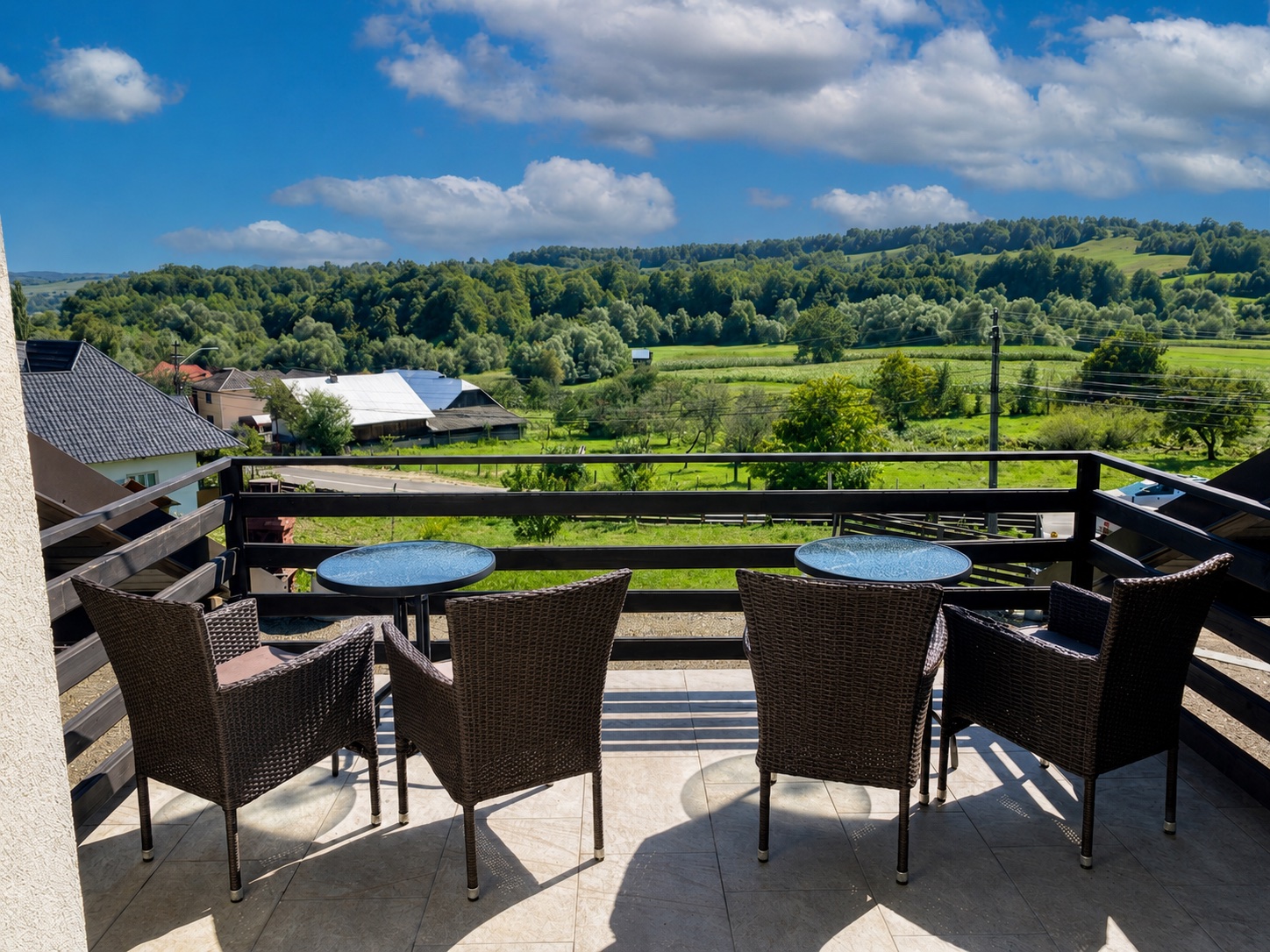
Mornings with fresh air, evenings in the gazebo, family meals and views over the green hills around. Here you can enjoy Bucovina at a slower pace, close to nature and to places steeped in tradition.
Bine ai venit la Casa Bucovineană!
A deluxe double room with its own bathroom and generous natural light — quiet comfort for a stay for two. We have several double rooms; we confirm the available one for your dates.
A spacious apartment with two bedrooms, a wardrobe area and its own bathroom — ideal for families or small groups.
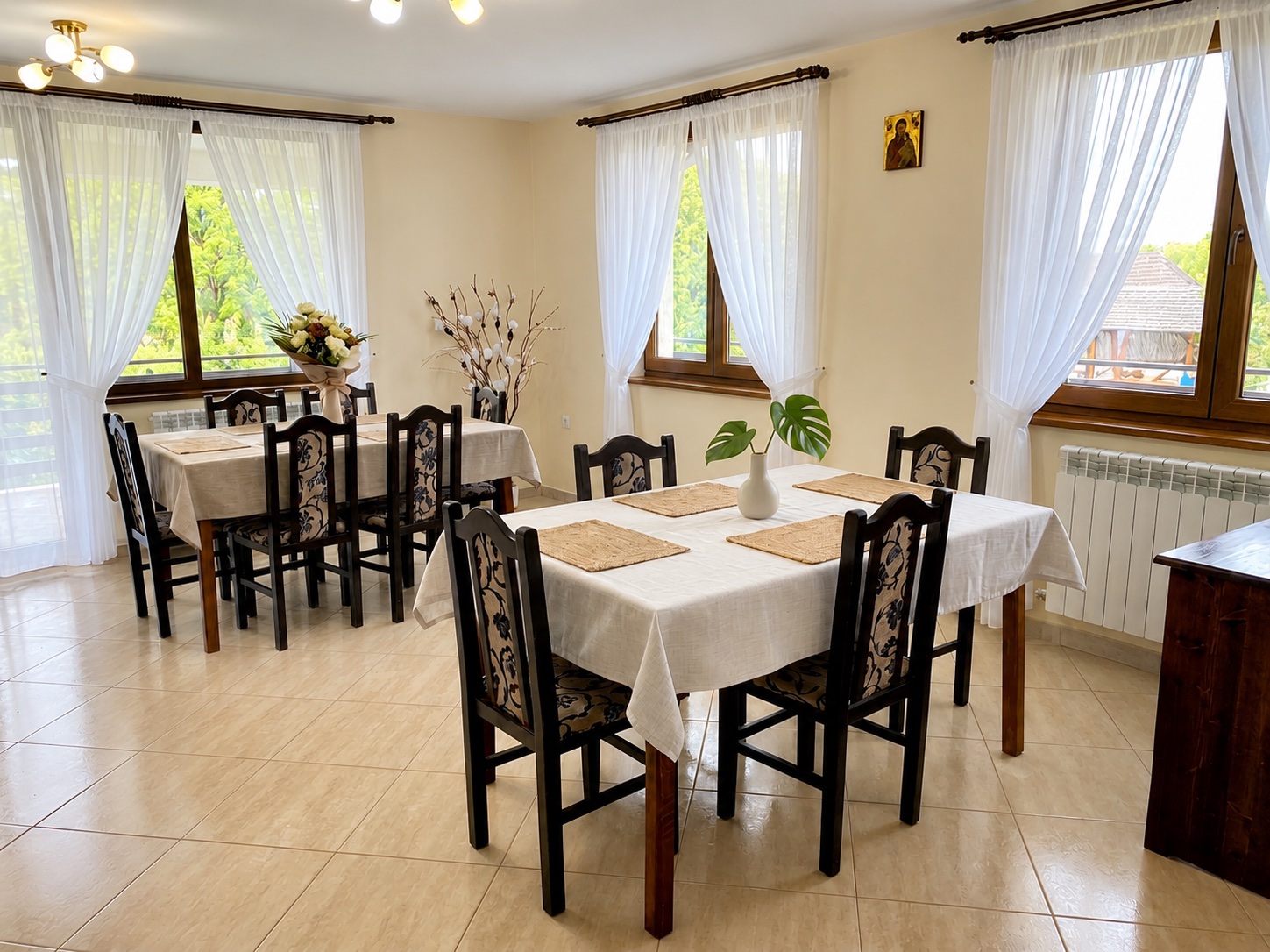
The entire property, just for your group: 350 m² with 4 rooms, an apartment, a living room and a fully equipped kitchen — for up to 10 adults and 2 children.
The Cacica Salt Mine is one of the oldest salt mines in Europe, remarkable for its hand-carved galleries, generous spaces and the special atmosphere of its underground world. Built in 1791 by order of Empress Maria Theresa, it began as a working salt mine and is today one of Bucovina's most distinctive tourist attractions.
To reach the interior, visitors descend 192 fir-wood steps, mineralised over time by brine. The galleries lead down to depths of about 44 metres, where you can admire vaulted ceilings, stairways cut into the salt massif and impressive chambers shaped by the miners' painstaking work.
The underground temperature stays constant at around 14°C whatever the season, and the salt aerosols are valued for their therapeutic effects, especially on the airways. If you notice a petrol-like smell on the way down, it comes from the contact between water and the salt used in the extraction process.
Beyond its touristic and historical value, the Cacica Salt Mine is also appreciated for its microclimate, rich in salt aerosols. Nearby, visitors will find leisure and relaxation options such as the mine's salt-water pool (Ștrandul Salinei), valued for its relaxing effects and its use in balneotherapy. Salt-water baths can be particularly beneficial for fatigue, stress, muscle and joint problems, rheumatic conditions, arthrosis or spondylosis, rounding off the experience of a visit to the Cacica Salt Mine.
During the visit, tourists can discover more about the mine's history, the old salt-extraction methods and the role this place played in the development of the area. The peaceful atmosphere, constant microclimate and salty air make the experience ideal for relaxation and leisure alike.
After descending the 192 steps, you arrive in a place with an atmosphere all of its own, where you can drink a coffee deep inside this centuries-old salt mine — a simple but memorable experience.
Humor Monastery – a jewel of Bucovina.
Humor Monastery is one of the most renowned places of worship in Bucovina, the historical region in north-eastern Romania. It is best known for its unique frescoes, which give it inestimable artistic and cultural value.
History and architecture
Humor Monastery was built at the beginning of the 16th century, during the reign of Petru Rareș. The building is constructed in the Moldavian style, with a single tower and a façade adorned with geometric and floral motifs. Within the monastery stands a church dedicated to the Dormition of the Mother of God, along with other buildings such as the bell tower and the monks' cells.
One of the most important features of Humor Monastery is its exterior fresco, which covers the entire place of worship. It is one of the best-preserved frescoes in Bucovina, recognised throughout the world for its vivid colours and precise details. The frescoes depict biblical and apocalyptic scenes, as well as figures of Orthodox saints.
Humor Monastery was inscribed on the UNESCO World Heritage List in 1993, together with seven other monasteries in Bucovina. This was a recognition of the historical and cultural value of the site, as well as a way to protect and promote it internationally.
Tourism
Humor Monastery is one of the most important tourist attractions in Bucovina, visited every year by thousands of tourists from all over the world. Visitors can explore both the interior of the monastery and the exterior frescoes, which are a special attraction. Tourists can also explore the monastery's surroundings, which are just as beautiful.
The Gura Humorului ski slope – a wonderful winter destination for ski lovers
The Gura Humorului ski slope sits at an altitude of 850 metres and is 1,200 metres long. It is equipped with snow cannons to ensure optimal skiing conditions even when there is no natural snow. The slope is also well maintained and clean, offering a pleasant and safe skiing experience for all visitors.
Ski runs
The Gura Humorului ski slope has runs for all levels of experience. Beginners can choose the easy runs with gentle gradients, perfect for starting to learn the basics of skiing.
Intermediate skiers can opt for more difficult runs, with steeper gradients and tighter turns. For advanced skiers there are extremely difficult runs, with steep slopes and highly technical sections that represent a real challenge.
The Gura Humorului ski slope is also a popular destination for snowboarding, offering a variety of obstacles and ramps for riders looking for a more extreme experience.
Facilities
The Gura Humorului ski slope offers a full range of facilities for skiers, including ski and snowboard equipment rental, instruction and guiding services, as well as a leisure area with a variety of restaurants and cafés.
In conclusion, the Gura Humorului ski slope is a wonderful winter destination for skiers and snowboarders of all experience levels. With excellent runs, complete facilities and an easily accessible location, this destination is definitely worth a visit.
To enjoy all the beauty and experiences the Gura Humorului ski slope has to offer, we recommend staying in the Câmpulung Moldovenesc area, where you will find a variety of accommodation options.
The Forest Coaster in Gura Humorului is a rail-mounted sled that descends through the forest along a winding track of about 1,400 m. With speeds of up to 40 km/h, the route includes impressive spirals — including double and triple ones — offering a thrilling yet safe experience for all riders.
The ride begins with a cable-drawn climb of about 300 m, followed by a controllable descent of 5–8 minutes, during which each visitor can adjust their own speed with a brake lever. A visit here delivers the adrenaline and freedom of a mountain roller coaster in stunning natural surroundings — perfect for families or adventurers of all ages.
The Ferris wheel stands in Ariniș Park and is 50 metres tall. It has 24 cabins, each seating four people, and a ride lasts about 10 minutes. The cabins are both semi-open and enclosed, the latter being air-conditioned in summer and heated in winter.
Arbore Church is a historic monument located in the commune of Arbore, Suceava County. It was built in 1503 by Hatman Luca Arbore and is one of Bucovina's famous churches with exterior paintings.
Its frescoes, painted in 1541, impress with their shades of green and their detailed religious scenes. The church is dedicated to the Beheading of Saint John the Baptist and is part of the UNESCO World Heritage.
A storybook world has come to life in the heart of Bucovina, at Gura Humorului. The Hobbit Park is the newest spot in this well-known tourist resort, where children can have fun like never before. A castle and five little houses built underground bring Tolkien's fantasy world from The Lord of the Rings to life.
The Egg Museum in Ciocănești: a unique cultural experience in Bucovina.
If you are travelling through Bucovina and looking for a truly unique cultural experience, then the Egg Museum in Ciocănești is a must-visit.
This museum, one of a kind in the world, houses an impressive collection of decorated eggs, representing a variety of traditional styles and techniques from across the Carpathian region.
The history of the Egg Museum
The Egg Museum in Ciocănești was founded in 1998 by Mrs Elena and Mr Ion Stan, two local artists who dedicated their lives to collecting and restoring decorated eggs. The collection kept growing, and in 2004 the Egg Museum officially opened to the public.
The attractions of the Egg Museum
The museum's impressive collection of decorated eggs showcases a variety of traditional styles and techniques from across the Carpathian region, including eggs decorated with wax, with wax and water, with wax and oil, eggs adorned with gold leaf, and many more.
Each egg is unique and represents a little piece of traditional art.
In addition, the Egg Museum organises egg-decorating workshops for tourists, where you can learn traditional decorating techniques and create your very own one-of-a-kind egg.
The Egg Museum in Vama, Bucovina, houses over 11,000 decorated eggs from Romania and 82 other countries. Founded by the artist Letiția Orșivschi, the museum displays traditional Bucovinian eggs, international pieces and eggs made from various materials such as porcelain, glass or volcanic lava.
The exhibits include painted, engraved and perforated eggs, and even rare emu, crocodile or flamingo eggs. Visitors can also discover eggs with unique designs, such as the "horseshoed" eggs from Hungary or the "scratched" eggs from Germany.
The Marginea Ceramics Centre: discover the pottery tradition of Bucovina.
If you are passionate about art and tradition, then you must visit the Marginea Ceramics Centre in Bucovina.
This museum, unique in the world, offers you the chance to learn and experience the art of pottery under the guidance of experienced local artists.
The museum houses an impressive collection of traditional ceramics, featuring a wide variety of shapes, patterns and colours. The pieces are handmade in the traditional manner, and the decorations are created using specific techniques.
The history of the Ceramics Centre
The Marginea Ceramics Centre was founded in 1999 by the well-known local artist Iosif Nemeș. He wished to promote and preserve the pottery tradition of Bucovina, and the centre has become a popular destination for tourists and art collectors from all over the world.
The attractions of the Ceramics Centre
The Marginea Ceramics Centre houses an impressive collection of traditional ceramics, including pots, mugs, jugs and much more.
The ceramic pieces are handmade, and the decorations are created using traditional techniques.
Besides visiting the museum, tourists can also take part in pottery workshops, where they can learn pottery techniques and create their own ceramic pieces under the guidance of a local artist.
Sucevița Monastery is a major historical and religious monument in northern Moldavia, renowned for its celebrated paintings and its unique architecture. Located near the town of Rădăuți, the monastery is a popular tourist destination, drawing visitors from all over the world.
Built in the 15th century, the monastery was originally conceived as a fortress and was turned into a religious centre at the beginning of the 17th century.
The monastery's main building, the Church of the Holy Trinity, is a remarkable example of Moldavian architecture, blending Gothic and Byzantine elements.
Another notable feature of the monastery is its impressive series of murals, which cover the church's interior and exterior walls. Painted in the 16th century, they depict biblical and historical scenes as well as images of saints and angels. They are remarkable not only for their artistic detail but also for their brilliant colours and their quality, and are considered one of the most valuable collections of mural paintings in the world.
Besides the main building, Sucevița Monastery also comprises a number of other buildings and structures, such as the defence tower, cells, monks' quarters and a folk-art museum.
If you wish to visit Sucevița Monastery, it is important to be respectful and to dress appropriately. Women should wear long skirts and cover their heads, while men should wear long trousers and avoid T-shirts or other unsuitable clothing.
There are also many interesting things to do in the area, including hiking through the forests and visiting other nearby monasteries, such as Putna and Voroneț.
Beyond its historical and cultural significance, Sucevița Monastery also offers a profound religious experience. The monks who live there hold services and invite visitors to join them in prayer.
If you are interested in Romania's history and culture, a visit to Sucevița Monastery is essential. It is a unique opportunity to experience the beauty and splendour of a historic building and to understand the importance of Moldavia's culture and traditions.
In conclusion, Sucevița Monastery is a treasure of Romanian culture and history, an unforgettable tourist destination and a unique spiritual place. Whether you are interested in art, history or religion, Sucevița Monastery is certainly a place you must visit.
Sucevița Monastery is one of Romania's major historic monuments, dating from the end of the 16th century.
On a journey to visit the monasteries from the time of Stephen the Great and his successors, the traveller who arrives at Sucevița Monastery finds himself before an entire spiritual universe. Beginning with the architecture of the complex, which resembles a fortified citadel or a princely court, with the church at its centre, the monastery presents itself as a core of Orthodox faith that still preserves the charm and atmosphere of ancient monastic life.
The uniqueness of the monument also lies in its exterior painting, whose brilliance has withstood time and weather for almost four centuries — which is why, alongside the other monuments of northern Moldavia, it stands as a precious landmark in the history of universal art.
The church of Voroneț Monastery — a ship of stone, full of grace, simplicity and charm — impresses through its verticality, its harmonious proportions and the solidity of its massive walls.
Against an intensely luminous blue background, the exterior frescoes unfold across the façades like a carpet laden with colour. The famed 'Voroneț Blue' is considered by specialists to be unique in the world, as renowned as Rubens' red or Veronese's green.
At Voroneț, more than anywhere else, painting is a prayer for the defeat of invaders and the salvation of the Land of Moldavia.
Palma Pass is one of the most picturesque spots in Bucovina, lying at an altitude of 1,100 m on the road linking Moldovița to Sucevița. Its name comes from a local legend, according to which the roads of two worlds – Moldavia and Transylvania – once met here, and those parting ways would say goodbye by raising a hand in greeting.
Today, the symbol of the place is a huge sculpture in the shape of an open palm, set right in the pass. It represents the hospitality of the people of Bucovina and the warm welcome given to all who pass through these lands. From this point, the view is breathtaking: gentle hills, endless forests and villages scattered across the valleys, all forming a perfect picture of Bucovina.
Alongside the huge palm-shaped sculpture, at Palma Pass you will also find a panoramic swing, placed in a perfect spot for admiring Bucovina's spectacular scenery.
Moldovița Monastery – a historical and spiritual landmark of Bucovina.
Moldovița Monastery is one of the oldest and most important monasteries in Romania, located in Suceava County, in the Bucovina region. This place of worship was built in the 16th century and is one of the seven monasteries on the territory of Moldavia that were inscribed on the UNESCO World Heritage List in 1993.
The history of Moldovița Monastery
Moldovița Monastery was built between 1532 and 1537, during the reign of Petru Rareș, by the voivode of Moldavia, in the Moldavian architectural style. The monastery was initially dedicated to the Dormition of the Mother of God, and later, in the 17th century, a side chapel dedicated to Saint George was added.
Over the course of its history, the monastery was destroyed several times, but it was always restored and brought to its present state. Today, Moldovița Monastery is one of the most important historical and spiritual monuments in Romania, attracting numerous tourists from all over the world every year.
The architecture and frescoes of the monastery
Moldovița Monastery stands out for its distinctive architecture, typical of the Moldavian style. The monastery building is made of stone and brick, with thick walls and massive towers. The facade is decorated with a series of frescoes that give it a truly special appearance.
The frescoes of Moldovița Monastery are the best conserved and best preserved frescoes of all the monasteries in Bucovina. They were created between 1537 and 1538 by anonymous masters from the Moldavia region and depict scenes from the Old and New Testaments. Painted in vivid, radiant colours, they illustrate important events from the life of Jesus Christ as well as of other saints.
Moldovița Monastery is a major tourist attraction in Romania, drawing numerous visitors from all over the world each year. It offers tourists the chance to admire its unique frescoes and to enjoy the peaceful beauty of the place.
Besides visiting the monastery itself, tourists can also explore its surroundings, which are just as beautiful. The area offers plenty of hiking trails leading into the mountains and forests, with spectacular views over the region.
Mocănița Huțulca: an unforgettable experience in the Eastern Carpathians.
If you are passionate about nature and adventure, the Mocănița Huțulca should be on your list of destinations to visit in Romania. This steam locomotive still runs through the rural areas of the Eastern Carpathians, offering a unique and authentic travel experience.
The history of the Mocănița Huțulca
The Mocănița Huțulca is a narrow-gauge railway built between 1898 and 1910 to carry timber down from the mountains of Bucovina.
It was built as a matter of urgency after the territory of Bucovina was integrated into the Kingdom of Romania. The Mocănița Huțulca thus became one of the most important narrow-gauge railways in Romania.
Today, the Mocănița Huțulca is a popular tourist attraction and one of the best-preserved narrow-gauge railways in Europe. It starts from the town of Vatra Dornei and crosses the mountains of Bucovina, passing through remarkable scenery, dense forests and steep gorges.
The travel experience
A ride on the Mocănița Huțulca is an unforgettable experience. The steam locomotive, the carriages and the narrow train sets create a storybook atmosphere, recalling the days when travelling was an adventure in itself.
The journey takes about four hours, during which travellers can admire the spectacular landscapes of the Eastern Carpathians. Along the route, the train passes through tunnels and over bridges and viaducts that are true works of art. Visitors can admire waterfalls, rivers and impressive gorges that will leave them speechless.
During the trip, travellers can opt for a stop at one of the monasteries in the area or visit a spruce forest. The train also stops at several stations along the way, where visitors can meet the locals and discover their traditions and customs.
An unforgettable journey in Bucovina
If you come to Bucovina, besides the famous painted monasteries, you must not miss an unusual trip on the Moldovița steam train — the "Huțulca", as the locals call it. The old steam train will take you on an unforgettable journey into the fairy-tale land of the Hutsuls…
It is like a journey back in time, through their villages, with picturesque houses strung along the Moldovița river. At every bend, around every corner, you are sure to find something to see and photograph!
Whether you wish to relax in salt water or unwind in the sauna, the Solca Salt Baths complex welcomes you with open arms for an unforgettable experience in a natural, restorative setting.
Address: Tomșa-Vodă St. no. 6A, town of Solca, Suceava County.
The first theme park inspired by Romanian fairy tales and stories. It covers an area of around 2 ha and is divided into three sections, each with plenty of attractions for every taste: Open the Book of Romanian Fairy Tales, the World of Fun and the Land of Relaxation.
With this new attraction, the Dumbrava Minunată Complex has become the perfect destination for the whole family, who will step into a world inspired by fairy tales.
The Istrati ski slope in Câmpulung Moldovenesc is one of the most popular destinations for winter-sports lovers in Romania.
Located in Suceava County, this slope offers a wonderful skiing and snowboarding experience, with impressive views of the Carpathian Mountains.
The Istrati ski slope in Câmpulung Moldovenesc suits beginners and advanced skiers alike, with a length of about 1,200 metres and a vertical drop of 230 metres. The slope is served by a modern chairlift that can carry up to 1,000 people per hour.
Alongside the main ski area, the slope also includes a children's zone, where the little ones can learn to ski in safety. There is also an area for snowboarding, with obstacles and half-pipes.
The slope is usually open from December to March, depending on weather and snow conditions. In addition, there is an après-ski area, where visitors can relax and enjoy a hot drink or a snack after a long day on the slopes.
Whether visiting the slope for the first time or returning here regularly, guests also have the option of renting the ski or snowboard equipment they need. These services are offered at the base of the slope by local operators.
To enjoy all the beauty and experiences the ski slope has to offer, we recommend staying in the Câmpulung Moldovenesc area, where you will find a wide range of accommodation options.
The Wood Art Museum in Câmpulung Moldovenesc is a unique tourist destination in Romania, an oasis of local traditions and crafts expressed through wooden sculptures and pieces of furniture.
Founded in 1936, the museum is one of the oldest in Romania and was inaugurated on the occasion of the 25th anniversary of the coronation of King Carol II of Romania.
The museum's permanent exhibition includes over 7,000 wooden objects, among them sculptures, traditional furniture and household items, all made by local craftsmen. Visitors can admire a variety of carving styles and techniques, including folk art, Baroque and Rococo.
The Wood Art Museum in Câmpulung Moldovenesc is open Tuesday to Sunday, from 10:00 to 18:00, and closed on Mondays. Admission is 10 lei for adults and 5 lei for pupils and students.
To make the most of your visit to the Wood Art Museum, you can opt for a guided tour, which will allow you to explore local history and traditions in greater depth.
The museum also organises wood-carving workshops, where you can learn traditional carving techniques from local craftsmen.
In short, the Wood Art Museum is a remarkable tourist destination that will offer you a fascinating insight into local history and craftsmanship through its wooden sculptures and furniture.
The Moara Dracului Gorge in Câmpulung Moldovenesc is one of the most beautiful tourist attractions in Suceava County, offering an impressive experience for those who wish to explore the wild nature of the area.
Located just a few kilometres from the town of Câmpulung Moldovenesc, the Moara Dracului Gorge is a narrow defile carved into the limestone rock by the Moldova River.
The area is characterised by huge rock formations and picturesque waterfalls that follow one another along the exploration trail.
The gorge is accessible to tourists all year round, except in winter, when snowfall and ice can make the trail dangerous.
In summer, the Moara Dracului Gorge is a popular spot for hiking and day trips, and the trails can be tackled by visitors of all experience levels.
To reach the Moara Dracului Gorge, there is a marked trail of about 4 km that starts from the centre of Câmpulung Moldovenesc.
Another impressive aspect of the Moara Dracului Gorge is the wildlife living in the area. Here you can see animal species such as the brown bear, the wolf, the lynx and the wild boar. It is important to be careful and respect these wild animals, keeping a safe distance and leaving no litter behind.
In conclusion, the Moara Dracului Gorge is an impressive tourist attraction, offering an unforgettable experience for those who love nature and adventure.
Thanks to its accessibility and spectacular scenery, the gorge is an excellent choice for a day hike or a long weekend. Moreover, for those interested in ecotourism and wildlife watching, the Moara Dracului Gorge is a great place to see animals such as the brown bear, the wolf or the wild boar in their natural habitat.
Nestled at the north-eastern foot of the Rarău massif, on the upper course of the Valea Caselor stream, the Moara Dracului Gorge is the most beautiful and best-preserved gorge in the whole area. It is part of a protected geological and morphological reserve covering an area of around 10 hectares.
The gorge is 60–70 m long, with an average width of 4–5 m. Its walls rise vertically, in places even overhanging. Around the gorge you can still find a few yew trees — a glacial relict, the golden wood of our forests of old — as well as rarities of the plant and animal world such as edelweiss, bellflowers and hawkweed, or the lynx, the marten, the fox and others.
Bucovina Panorama is a place where you can relax with friends or family.
At Bucovina Panorama you will find a fire pit, a barbecue area, spots to unwind, a camping area, a swing overlooking beautiful Bucovina and a superb spot for photos from up high.
The Rarău ski slope is a popular destination for winter-sports lovers in the Rarău Mountains, located near the town of Câmpulung Moldovenesc.
The area offers plenty of entertainment options for tourists, including skiing, snowboarding, hiking and more.
Sitting at an altitude of 1,465 metres, the Rarău ski slope offers impressive panoramic views of the Rarău Mountains and the surrounding area.
It is a slope of medium difficulty, 1.5 kilometres long, starting from the Gura Haitii chalet and ending at the base of the slope. It is equipped with a chairlift and artificial snow cannons, which ensure optimal skiing conditions throughout the winter season.
In conclusion, the Rarău ski slope is an excellent destination for those who want to enjoy winter sports and the natural beauty of the Rarău Mountains.
With optimal skiing conditions, comfortable accommodation options and tourist attractions nearby, Rarău is a destination well worth considering when planning your winter holiday.
Dragomirna Monastery, located in Bucovina, is a true jewel of Romanian medieval architecture, impressing with its high walls and the elegance of its carved details.
Founded in 1609 by Metropolitan Anastasie Crimca, the monastery stands out for its unusually tall proportions and for its fine frescoes, which blend Byzantine and Renaissance influences. The peaceful atmosphere and the spiritual depth of the place make it an unmissable destination for lovers of history and religious art.
The Princely Citadel of Suceava – the story of a historical treasure of Bucovina.
The Princely Citadel of Suceava is one of the most important tourist attractions in Bucovina, representing one of the most impressive examples of medieval architecture in Romania.
Built in the 14th century, the fortress was for centuries the princely residence of the voivodes of Moldavia and has been declared a historical monument of national importance.
The citadel is located in the centre of the city of Suceava and is built on a hill, thus offering an impressive panorama of the surrounding area.
The fortress consists of four massive towers, each over 30 metres tall, and solid stone walls that protected it from enemy attacks.
Inside the citadel stands the Princely Palace, an impressive complex of buildings that hosts numerous exhibitions and museums. Among the most important of these is the Museum of History and Ethnography, which presents an impressive collection of historical artefacts, folk art objects and items of material culture.
Suceava Fortress, also known as the Seat Fortress of Suceava, was built between 1375 and 1391 by Voivode Petru I Mușat. The medieval fortress stands on a plateau some 70 metres above the Suceava river meadow.
Over time the fortress served, together with the other fortifications, as a defensive stronghold for the inhabitants during the Ottoman attacks, suffering extensive damage in those assaults. It was fortified in the 15th century by Stephen the Great and destroyed in the 17th century (1675) by Dumitrașcu Cantacuzino; today only a few ruins remain to recall its turbulent past.
Built at the end of the 14th century near the medieval town of Suceava, the fortress was the main residence of the rulers of Moldavia for nearly 200 years, and today it is a historic monument of national importance.
The overall picture of the Bucovina Village Museum reflects the organisation and complex life of the traditional village: the architecture of the households and community buildings, the technical installations illustrating the occupations, trades and crafts of the region, and the way of life of the people of Bucovina.
Alongside the households made up of houses and outbuildings, laid out along the lanes, the heart of the village — the focal point of community life — holds the church and bell tower from Vama, the tavern from Șaru Dornei and the school from Securiceni.
Trades and crafts are represented in workshops equipped with the tools specific to each craft; traditional working techniques can be demonstrated and learned here, and the workshops are used as teaching studios for children and tourists.
Daniil the Hermit's Cell is a small cave in the Rarău Mountains of Bucovina — a grotto carved into a rock in the valley of the Vițău stream, where the Venerable Daniil the Hermit lived as a recluse. He was one of the best-known hermits in the history of Romanian Orthodoxy, renowned for his life of prayer, meditation and asceticism.
It lies about 1 km from Putna Monastery, at an altitude of roughly 1,200 metres. Despite its modest size, this cell is a symbol of Romanian spirituality and monastic tradition.
Pietrele Doamnei on Rarău – a natural wonder in the heart of the Rarău Mountains
Pietrele Doamnei (the Lady's Stones) is one of the most spectacular sights in the Rarău Mountains. Standing at an altitude of 1,650 metres, it offers a panoramic view over the area and is an ideal spot for nature lovers and hikers.
Pietrele Doamnei is an impressive geological formation made up of two huge rocks rising more than 40 metres above the ground.
They are called 'the stones' because of their unusual shape, resembling objects carved by human hands.
Hiking and trails
Pietrele Doamnei is a popular spot for hiking and excursions in the Rarău Mountains. Several hiking trails start near the Stones, passing through coniferous forests, alpine meadows and rocky terrain.
One of the most popular trails leads to Rarău Peak, the highest summit in the Rarău Mountains, at an altitude of 1,650 m.
Facilities
At the foot of Pietrele Doamnei there is a car park and a tourist information point, where visitors can get information about the hiking trails and other sights in the area.
There is also a picnic area where visitors can enjoy a snack or a cold drink while taking in the spectacular view.
Transrarău is a remarkable tourist route located in the Rarău Mountains of Romania.
The area is renowned for its natural beauty, with forest-covered hills, streams and deep valleys. The Transrarău route offers a unique perspective on this natural beauty and is a popular destination for tourists.
Among the most popular attractions along the Transrarău route are the Cailor Waterfall and Rarău Peak, at an altitude of 1,650 metres. These viewpoints offer an impressive panorama of the surrounding areas, giving a unique perspective on the natural beauty of the Rarău Mountains.
Beyond the natural beauty of the area, the Transrarău route also offers a unique cultural experience. Along the way you will come across several traditional Romanian villages, where you can see how the people of this region live and work.
You will also be able to taste traditional Romanian cuisine and buy local products such as burduf cheese and honey.
In conclusion, Transrarău is a wonderful tourist destination for those who want to discover the natural and cultural beauty of the Rarău Mountains. With a variety of natural landscapes and tourist attractions, the Transrarău route is a unique experience that combines adventure with local traditions.
The Skywalk platform on the Rarău Massif is the first of its kind in Romania – a 37 m² suspended walkway with a transparent glass floor and safety-glass walls, set on Piatra Șoimului at an altitude of around 1,530 m. From here, the 360° panorama over the Rarău, Giumalău, Călimani and Rodna Mountains and the Bistrița Valley is simply stunning.
The best experience comes on clear days, when the sky is reflected sharply in the glass and you can see thousands of metres beneath your feet – a moment that gives you the feeling of floating among the clouds.
Nestled in the heart of Bucovina, the area around Mount Rarău is an inexhaustible source of beauty thanks to its unspoiled nature, but also to its well-developed tourist infrastructure: there are decent roads, impressive mountain trails, and welcoming locals who greet visitors with surprising dishes.
The abandoned mine is a tunnel dug by the Austrians more than a century ago beneath the slope where the television relay stands. There are two exits. The first is on the right-hand side in the direction of travel and opens onto a steep drop, while the second, on the left-hand side, is the more spectacular, as it offers a panorama over the Izvorul Alb Valley and the town of Câmpulung Moldovenesc.
The Pietrele Doamnei – Rarău Nature Reserve is a protected area that has fascinated people since long ago, which gave rise to legends about this place. Among the local stories, the best-known legend recalls that Lady Elena and Petru Rareș lived here — the ruler who gave these mountains the name "Rarău". It is said that during his second reign, when the Turks invaded these lands, he hid his family and his fortune here.
Beyond the legends, the Pietrele Doamnei are very real: 70 metres tall and located at an altitude of 1,634 metres, in the Rarău Mountains.
The area is important for the richness of its endemic vegetation. The first geological research was carried out by Austrian geologists, who discovered that the area is formed of limestone with encrustations of corals, ammonites, marine algae and other elements that formed reefs more than 140 million years ago.
Iezer Lake in Sadova is one of the most beautiful natural lakes in Romania, located close to the town of Câmpulung Moldovenesc, in Suceava county. This lake of glacial origin sits at an altitude of about 1,400 metres and offers a spectacular view over the surrounding mountains.
About 1.5 kilometres long and 800 metres wide, Iezer Lake is an ideal spot for relaxation and recreation in the heart of nature. You can spend time outdoors here, whether strolling around the lake or enjoying a refreshing swim in its crystal-clear waters.
Iezer Lake is also a popular fishing spot, with a wide range of fish species such as chub, starry sturgeon, trout and pike. To fish in the lake, you need to obtain permission from the landowner. There is also a specially arranged area for picnics and barbecues, so you can spend a whole day here surrounded by nature.
If you wish to explore the area around the lake, there is a series of mountain trails for hiking and day trips that will let you discover the natural beauty of the Rarău Mountains. One of the most popular routes is the one leading to Rarău Peak, which offers an impressive view over the region.
In short, Iezer Lake in Sadova is an impressive tourist destination and an oasis of relaxation in the heart of nature. With its spectacular scenery and variety of leisure activities, this lake is an excellent choice for a day trip or even longer, to enjoy the natural beauty of the Rarău Mountains.
The Transrarău road is a mountain route that crosses the Transrarău region and links the Bistrița Valley with the Moldova Valley. It is considered one of the most spectacular mountain roads in the country, thanks to the impressive scenery it offers.
The road starts in the commune of Cârlibaba in Bistrița-Năsăud County and ends in the commune of Pojorâta in Suceava County. It is about 45 kilometres long and climbs to a maximum altitude of 1,416 metres at the Rotunda Pass.
Dragomirna Monastery, in Bucovina, is a true jewel of Romanian medieval architecture, impressing with its tall walls and the elegance of its carved detail.
Founded in 1609 by Metropolitan Anastasie Crimca, the monastery is remarkable for its unusually tall proportions and its fine frescoes, which blend Byzantine and Renaissance influences. The quiet atmosphere and spiritual weight of the place make it a must-see for lovers of history and religious art.
The Zugreni Gorge is a spectacular nature reserve located in Suceava County, along the Bistrița River, near the village of Holda. The gorge impresses with its steep slopes, imposing cliffs and wild landscapes. The area is ideal for hiking, climbing and photography, offering trails of medium difficulty.
It is a perfect destination for lovers of nature and adventure, offering spectacular scenery and a peaceful atmosphere, far from the bustle of the city.
The village of Ciocănești, in Suceava county, is a picturesque locality in the north of the country. It is famous for its traditional Bucovina-style houses, painted with motifs specific to the area in vibrant colours. The scenery is enchanting, with mountains and forests all around, offering a peaceful, authentic atmosphere. Authentic traditions and local crafts lend a special charm to this village.
The houses of Ciocănești are renowned for their rich, beautiful ornaments. These decorations are an integral part of the local tradition and are applied to the exterior of the houses, especially on gables, windows and other architectural elements. They include floral, geometric and animal motifs, all executed with great care and in vivid colours.
The ornaments are a symbol of Bucovina's rich cultural and artistic heritage and add a distinct, authentic charm to the village of Ciocănești.
The Vatra Dornei ski slope – a wonderful winter destination for skiers
The ski runs
The Vatra Dornei ski slope is 2.3 kilometres long, with a vertical drop of 450 metres. The slope is divided into three distinct runs, each suited to a different level of experience.
The beginners' run has a gentle gradient and is perfect for learning the basics of skiing. The intermediate run is more challenging, with steeper sections and tighter turns. For advanced skiers, there is an extremely demanding run with steep pitches and highly technical stretches.
Facilities
The Vatra Dornei ski slope is well maintained and equipped with snow cannons to ensure optimal skiing conditions. To make reaching the slope easy, there is a modern cable transport system with a gondola, a chairlift and a ski lift. In addition, there is a leisure area with a variety of restaurants and cafés, where skiers can enjoy a snack or a hot drink.
As for equipment, skiers can rent ski and snowboard gear at the base of the slope, and those who wish to improve their skiing skills can take advantage of instruction and guiding services offered by professionals.
In conclusion, the Vatra Dornei ski slope is a wonderful destination for skiers of all levels of experience. With excellent runs, complete facilities and an easily accessible location, it is certainly worth a visit during the winter season. You can always find more information about the Vatra Dornei ski slope and the other tourist attractions in the area.
The Lucina Stud Farm is one of the largest and best-known horse farms in Romania, located in the heart of the Carpathian Mountains, near the town of Câmpulung Moldovenesc.
The stud farm offers a unique experience for horse lovers and for everyone who appreciates the beauty of nature.
The Lucina Stud Farm was founded in 1856 and is known for breeding Hutsul horses and the Romanian Semigreu (semi-draught) breed. These breeds are prized for their resistance to cold and their adaptability to mountain areas, and the stud farm takes pride in its tradition of caring for and developing these hardy animals.
The farm offers a variety of services for horse lovers, including cart and horseback rides, guided tours of the farm and riding lessons for all levels of experience.
Visitors can choose to explore the rugged terrain and picturesque landscape along a hiking trail, or admire the horses as they roam the paddocks, where they can be watched playing and feeding.
The Lucina Stud Farm is also an ideal place for nature lovers, who can enjoy an impressive view of the Carpathian Mountains and discover the local flora and fauna. Here you can admire beautiful scenery, take unique photographs and relax in the clean, fresh mountain air.
Putna Monastery is one of the best-known monasteries in Romania and one of the most important religious and architectural foundations of Stephen the Great.
It is a major Romanian cultural, religious and artistic centre — manuscripts were copied here and precious miniatures created. The monastery holds a rich museum of embroidery, manuscripts, liturgical objects and icons.
Stephen the Great is buried here, alongside Maria Voichița, Maria of Mangop, Bogdan the Blind and other descendants down to Petru Rareș. In 1966, on UNESCO's recommendation, the 500th anniversary of the monastery's founding was marked worldwide.
They are majestic, full of grace, and if you are lucky, they will eat right out of your hand. Somewhere in Suceava County, high up in the mountains, you can admire deer amid a landscape straight out of a Romanian fairy tale.
This is the "Deer Farm", set at an altitude of 1,250 m in the Bistrița Mountains. It is truly a storybook place surrounded by mountains, where the scenery quite literally takes your breath away.
The stags and hinds, bearing names such as Ionel, Bambi, Barbunc, Monica or Olguța, can be admired from an observation point built at the top of a fir tree. They can also be petted when they come close to the fence of the huge enclosure they live in, and even fed from your hand.
The Church of the Holy Apostles Peter and Paul in the village of Panaci, Suceava County, is also known as the "Cathedral of the Mountains". This place of worship impresses with its unique architecture: it was built from volcanic rock brought from the Călimani Mountains, while the exterior decorative elements are made of locally produced fired brick.
The building is considered a symbol of Bucovina's faith and tradition, drawing many worshippers and tourists thanks both to its architectural beauty and to the mountain landscape in which it stands.
The Cathedral of the Mountains, dedicated to the Holy Apostles Peter and Paul, is a church painted both inside and out, and is listed as a historic monument.
Tinovul Mare Poiana Stampei: a paradise of biodiversity in Bucovina
Tinovul Mare Poiana Stampei is a nature reserve located in Suceava County, in the mountainous part of Bucovina.
This protected area impresses with its exceptional biodiversity, making it a true paradise for nature lovers. In this article, we will explore Tinovul Mare Poiana Stampei in more detail and see what makes it such a special place.
Where is Tinovul Mare Poiana Stampei located?
Tinovul Mare Poiana Stampei lies in northern Romania, in Suceava County, in a mountainous area at an altitude of approximately 900–1000 metres, and covers an area of around 260 hectares.
What makes Tinovul Mare Poiana Stampei so special?
Tinovul Mare Poiana Stampei is a protected zone, declared a protected natural area by Law no. 5 of 6 March 2000.
It is a remarkable ecosystem, representative of the mountainous part of Bucovina. Over time it was affected by human activities such as logging and construction, but today it has been declared a protected area and is maintained and conserved through special measures.
Tinovul Mare Poiana Stampei impresses with its biological diversity, hosting a wide variety of plant and animal species.
As far as the flora is concerned, there is a wide range of rare and protected plants, such as the field narcissus, the mountain bellflower, the white honeysuckle and the mountain bedstraw.
Among the animal species that can be encountered in Tinovul Mare Poiana Stampei are the brown bear, the wolf, the wild boar, the roe deer, the black woodpecker and the water snake.
Activities in Tinovul Mare Poiana Stampei
For nature lovers, Tinovul Mare Poiana Stampei offers a multitude of activities. Among the most popular are hiking, birdwatching, cycling and nature photography.
There are also marked hiking and cycling trails, which offer excellent opportunities to explore the surrounding nature. In addition, it is worth mentioning that car access is restricted in the protected area, so outdoor activities are more pleasant and less affected by the noise and pollution of the area.
For those interested in fishing, Tinovul Mare Poiana Stampei also offers excellent opportunities for sport fishing. It is important to note that fishing is only allowed during certain periods of the year and with certain restrictions.
In conclusion, Tinovul Mare Poiana Stampei is a wonderful place for nature lovers, offering a multitude of outdoor activities and excellent opportunities for observing the local flora and fauna.
This natural paradise is an example of a healthy, well-preserved ecosystem, protected by law. If you are looking for a place to relax and enjoy the beauty of nature, Tinovul Mare Poiana Stampei is the perfect place for you.
Bucovina's most beautiful secret. Tinovul Mare is a botanical nature reserve offering you 682 hectares of paradise. For a great many visitors it turns out to be the true surprise of their holiday in Bucovina.
The Tinovul Mare Poiana Stampei themed trail has been laid out along a linear visiting route, on a wooden boardwalk that crosses the peat bog over a distance of about 1 km.
Along the wooden boardwalk, here and there, you will come across tourist interpretation panels, in Romanian, offering important information about the bog: how it was formed, what plants and animals shelter here and why it is important to keep this place just as we found it.
Check-in is from 3:00 PM and check-out is until 11:00 AM. If you need different times, message us and we will try to accommodate.
We are in Cacica, Suceava county, in Bucovina, steps from the Cacica Salt Mine and a short drive from the painted monasteries of Voroneț, Putna and Dragomirna.
Yes, guests have free private parking in the guesthouse courtyard.
Yes. The entire property is 350 m², with 4 rooms and an apartment, sleeping up to 10 adults and 2 children — ideal for families and groups.
Pets are accepted on request. Please let us know before booking.
Payment is by cash or bank transfer, with a deposit when the booking is confirmed.
We speak Romanian, English and Ukrainian, and the website is available in five languages, including German and French.